
Automated External Defibrillators (AEDs) in the Workplace: A Compliance and Strategy Guide
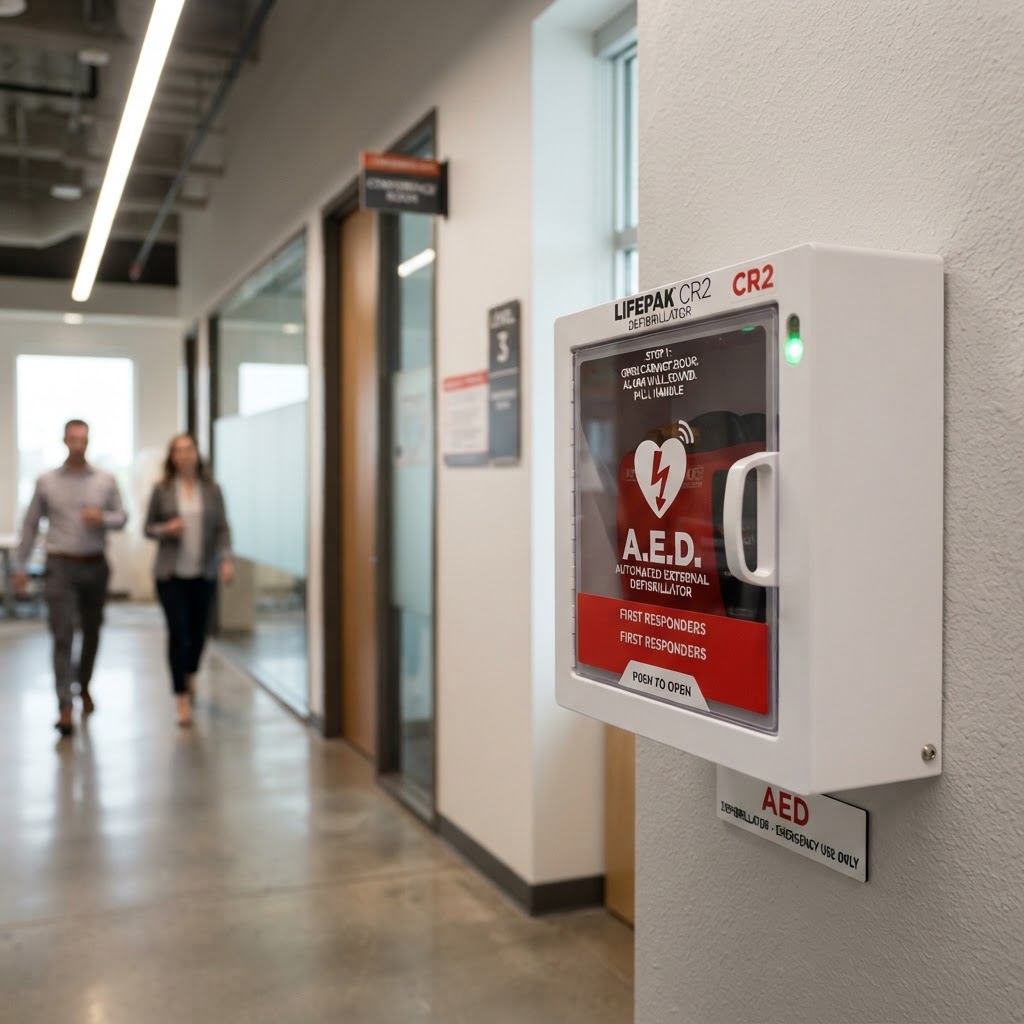
Automated External Defibrillators (AEDs) in the Workplace: A Compliance and Strategy Guide
Sudden Cardiac Arrest (SCA) can happen to anyone, at any time, often without warning. In the UK, survival rates for out-of-hospital cardiac arrests remain lower than desired, but the presence of an Automated External Defibrillator (AED) and trained staff can increase survival rates significantly. For UK employers, the question is no longer just 'should we have an AED?' but 'how do we manage it effectively?'
The Legal Landscape of Defibrillators in the UK
While the Health and Safety (First Aid) Regulations 1981 do not explicitly state that every business must have an AED, they do mandate that employers provide 'adequate and appropriate' equipment to render first aid. For many organisations—especially those with high footfall or vulnerable populations—a risk assessment will increasingly identify an AED as a necessary piece of life-saving equipment. Learn more about our First Aid at Work courses to understand how to build a robust safety culture.
Why AEDs are a Business Imperative
Beyond legal compliance, installing an AED is a moral imperative and a cornerstone of corporate social responsibility. A cardiac arrest results in a 10% decrease in the probability of survival for every minute that passes without defibrillation. Having a device on-site demonstrates a commitment to employee wellbeing and creates a safer environment for customers and visitors alike.
Choosing the Right AED for Your Facility
Not all AEDs are the same. When selecting a unit, consider the user interface, ease of maintenance, and the types of pads available. Some units are designed specifically for lay-responders, providing clear voice prompts that guide the user through CPR and shock delivery. It is essential to choose a device that matches the capability of your staff. We recommend viewing our Basic Life Support training to see how modern training integrates with current AED technology.
Maintenance and Governance: The Hidden Challenge
An AED is only as good as its maintenance. Batteries have an expiry date, and electrode pads lose their conductive gel over time. A common compliance failure is having a device on the wall that is effectively 'dead.' We suggest assigning a 'Defib Champion' in your office to perform monthly visual checks, ensuring the status light is green and the emergency kit is fully stocked.
Empowering Your Team: Training is Key
The most sophisticated AED in the world is useless if staff are intimidated by it. Our training programmes focus on reducing the 'fear factor' associated with medical emergencies. By integrating Emergency First Aid at Work training with specific AED simulation, your team gains the confidence to act decisively during those crucial first few minutes.
Key Takeaways
- AEDs are a critical life-saving asset that should be included in your site-wide risk assessment.
- Regular maintenance of batteries and pads is a non-negotiable compliance requirement.
- Employee confidence is the bridge between having a device and actually saving a life.
- If you need support with equipment selection or staff training, contact our team today for expert guidance.