
Sudden Cardiac Arrest: The First Three Minutes That Decide Everything
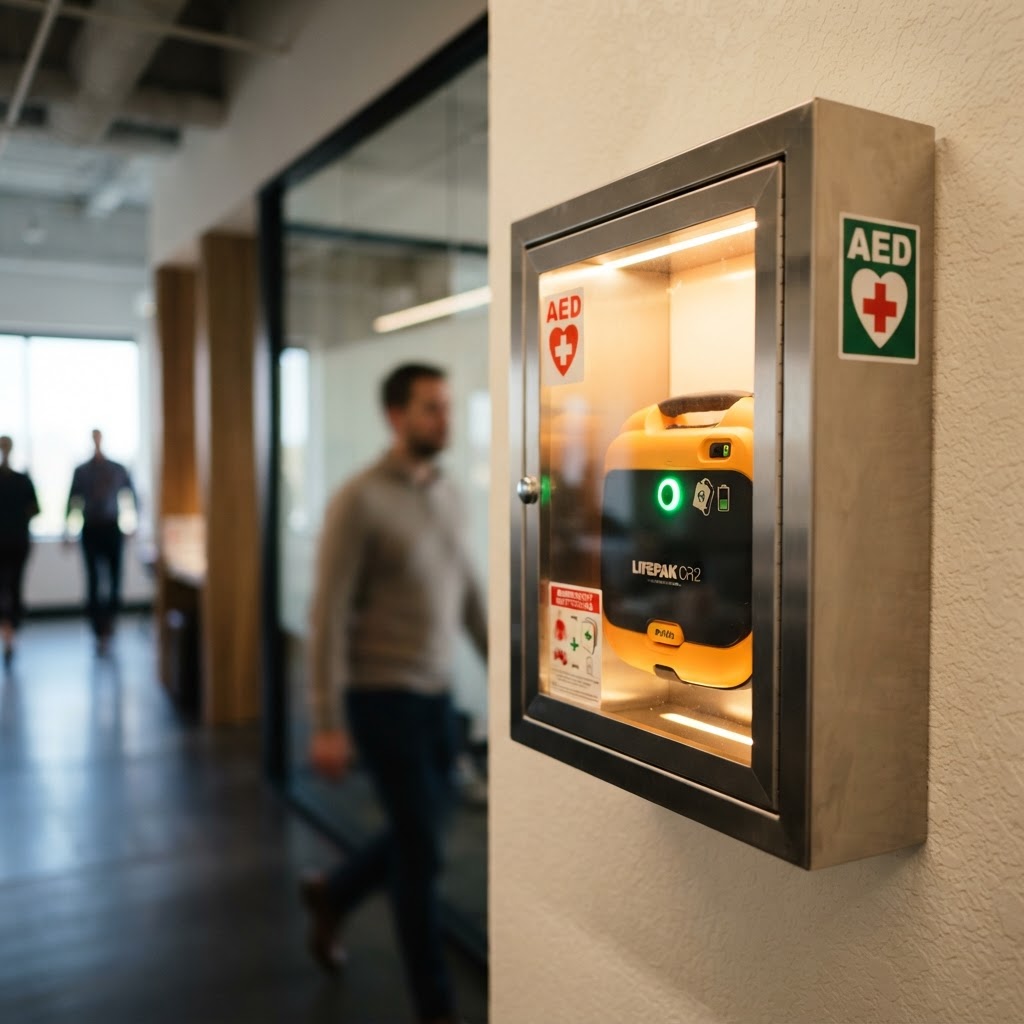
A pillar guide to bystander CPR, public-access defibrillation, and why the gap between collapse and clinical arrival is where most lives are won or lost.
This guide draws on the free public training resource published by Essex & Herts Air Ambulance (EHAAT), whose frontline clinical team produced a three-part video series to bridge the knowledge gap between an incident and professional arrival. Original source: ehaat.org/life-saving-first-aid.
Why this guide exists
Most people will never need to perform CPR. But if you do, the situation will arrive without warning, without an invitation, and without a rehearsal. The person on the floor could be a colleague, a parent, or a stranger on a train platform. What happens in the next three minutes — long before any ambulance or air ambulance reaches the scene — is the single biggest determinant of whether that person survives and in what condition.
This guide consolidates the clinical essentials: how to recognise cardiac arrest, how to perform compression-only CPR, and how to use a public-access defibrillator (AED). It references EHAAT's resource not because it replaces formal qualification — it doesn't — but because it represents the clearest, most accessible articulation of the bystander role we've seen from a UK pre-hospital service.
If you're an employer, a designated first aider, or someone who simply wants to be ready, this is the floor everyone should be standing on.
Table of contents
- The scale of the problem
- The chain of survival
- Recognising cardiac arrest
- DRs ABC: the first sixty seconds
- Compression-only CPR
- The defibrillator demystified
- Why bystander action outperforms everything else
- The EHAAT resource
- Where formal training fits
- Frequently asked questions
1. The scale of the problem
Out-of-hospital cardiac arrest (OHCA) is one of the leading causes of sudden death in the UK. Each year, tens of thousands of people experience an OHCA, and the survival rate without intervention is effectively zero within minutes. The Resuscitation Council UK consistently reports that survival to hospital discharge hovers in single-digit percentages nationally — a figure that climbs dramatically where bystander CPR and early defibrillation are delivered.
The gap between those two outcomes — near-certain death versus a meaningful chance of survival — is not a clinical mystery. It is a public knowledge problem. The interventions that work (chest compressions and a defibrillator shock) are simple, physically achievable by almost any adult, and taught in under thirty minutes. The barrier is not capability. It is confidence, recognition, and the willingness to act.
2. The chain of survival
The concept of the "chain of survival" frames cardiac arrest response as a sequence of time-critical links:
- Early recognition and call for help — identifying arrest and summoning emergency services.
- Early CPR — maintaining blood flow to the brain and heart.
- Early defibrillation — delivering a shock to reset a shockable rhythm.
- Post-resuscitation care — delivered once clinical teams arrive.
The first three links belong to the bystander. The fourth belongs to the ambulance service and, in the most serious cases, air ambulance crews like EHAAT's. What's striking is how much weight the chain places on people who are not clinicians — and how comparatively little formal training most of those people have.
3. Recognising cardiac arrest
Cardiac arrest is not a heart attack, though the two are often conflated. A heart attack is a plumbing problem: a blockage starving the heart muscle of blood. The person is usually conscious, in pain, and able to speak. Cardiac arrest is an electrical problem: the heart's rhythm suddenly fails, it stops pumping effectively, and the person collapses, loses consciousness, and stops breathing normally.
The signs are simple and should be over-called rather than under-called:
- Sudden collapse, unresponsive
- No normal breathing (occasional gasps are not normal breathing)
- No signs of life
If two of those three are present, start CPR. You will not harm someone by starting compressions who didn't strictly need them; you may kill someone by waiting to be sure.
4. DRs ABC: the first sixty seconds
EHAAT's first video covers DRs ABC — the structured approach that prevents the freeze response that overwhelms most untrained bystanders:
- D — Danger: Is the scene safe for you? Traffic, fire, water, electrical hazards.
- R — Response: Is the person responsive? A gentle shake and a loud "Are you alright?"
- S — Shout for help: Get someone to call 999 and locate a defibrillator.
- A — Airway: Open the airway with a head tilt, chin lift.
- B — Breathing: Check for normal breathing for no more than ten seconds.
- C — Circulation / CPR: If not breathing normally, start compressions.
The value of the framework is psychological as much as clinical. When the brain has a sequence to follow, the paralysis of "I don't know what to do first" dissolves. Sixty seconds of structured assessment is the difference between a bystander who freezes and one who acts.
5. Compression-only CPR
For adult sudden cardiac arrest, compression-only CPR — no rescue breaths — is the Resuscitation Council UK recommendation for untrained bystanders. The mechanics:
- Hand placement: Centre of the chest, lower half of the sternum.
- Depth: 5–6 cm (about two inches).
- Rate: 100–120 compressions per minute — the tempo of Stayin' Alive is the common mnemonic.
- Recoil: Allow the chest to come fully back up between compressions. Leaning on the chest prevents refilling and renders compressions ineffective.
- Interruptions: Minimise them. Every pause longer than ten seconds drops survival probability.
The goal is not to restart the heart. Compressions buy time by manually circulating oxygenated blood to the brain, keeping it viable until a defibrillator or adrenaline can address the underlying rhythm. The message from every resuscitation body is the same: doing something badly is infinitely better than doing nothing well.
6. The defibrillator demystified
This is where most people hesitate. There is a persistent public belief that AEDs are dangerous, complicated, or restricted to clinicians. None of that is true.
A modern public-access AED:
- Talks you through every step with voice prompts.
- Will not deliver a shock unless the internal analysis detects a shockable rhythm. You cannot shock someone who doesn't need it.
- Is designed for use by people with zero prior training.
- Is increasingly available in community settings: railway stations, leisure centres, village halls, supermarkets, and on the outside of many workplaces.
The sequence: open the case (turning it on), expose the chest, apply the pads as shown on the diagrams, stand clear when instructed, and resume CPR immediately after any shock. The device does the thinking. You do the compressions.
EHAAT's third video walks through this end-to-end in just over seven minutes. For anyone who has never held an AED, it is worth watching once — the unfamiliarity is the only real barrier, and it dissolves on first exposure.
7. Why bystander action outperforms everything else
Every minute without CPR and defibrillation reduces survival probability by roughly 10%. Ambulance response times in the UK, even at their best, rarely place a crew on scene inside that first critical window. Air ambulance services like EHAAT are extraordinary assets, but they exist to treat patients who reach them — which requires someone to have kept the patient alive in the interim.
The arithmetic is unforgiving and clarifying. If collapse goes unwitnessed and untreated for four to six minutes, the likelihood of a meaningful recovery collapses. If a bystander starts CPR within the first minute and an AED is applied within three to five, survival rates can reach 50–70% for shockable rhythms. The variable is not the paramedic. The variable is the person standing closest.
This is the case for universal basic first-aid literacy. It is also the case for ensuring every workplace, school, and public venue has a defibrillator that is accessible, signed, and known to its occupants.
8. The EHAAT resource

Image credit: Essex & Herts Air Ambulance — ehaat.org
Essex & Herts Air Ambulance is a charity-funded pre-hospital emergency service operating across Essex, Hertfordshire and surrounding areas. Beyond their operational mission — which costs over £1 million every month, more than £12 million annually, almost entirely community-funded — they run a Centre of Excellence committed to sharing clinical knowledge for public benefit.
Their life-saving first-aid video series comprises short modules:
- Introduction — framing the bystander role.
- DRs ABC — the foundational assessment.
- Performing CPR — compression-only technique.
- Using an AED — defibrillator essentials.
All are free, require no registration, and are delivered by the same clinical teams who fly to incidents. For any organisation reviewing its first-aid readiness, pointing staff to this resource is one of the highest-leverage, lowest-cost actions available.
Watch the full series: ehaat.org/life-saving-first-aid
9. Where formal training fits
Awareness resources save lives, but they do not constitute competence. For workplaces, regulated qualification is not optional — it is a legal and operational requirement under the Health and Safety (First-Aid) Regulations 1981 and the associated HSE guidance.
At Guardian Medical, we deliver the formal qualifications that turn awareness into auditable, certified capability:
- Emergency First Aid at Work (EFAW) — one-day qualification covering the immediate response to the most common workplace emergencies.
- First Aid at Work (FAW) — three-day qualification for designated first aiders in higher-risk environments.
- Basic Life Support and AED — focused CPR and defibrillation training for clinical and non-clinical teams.
- Paediatric First Aid — for settings caring for children.
The distinction matters. A video builds confidence; a qualification builds a paper trail, a verified skill standard, and a first aider your insurer, regulator, and workforce can rely on. If your organisation needs the latter, that's the conversation we're here to have.
10. Frequently asked questions
Is compression-only CPR as effective as CPR with rescue breaths? For adult witnessed cardiac arrest, yes — outcomes are comparable, and the simplicity increases bystander willingness to act. Rescue breaths remain important for paediatric arrests and drownings, where the cause is primarily respiratory.
Can I be sued for performing CPR on a stranger? In the UK, the Social Action, Responsibility and Heroism Act 2015 provides protection for those acting in good faith in an emergency. The risk of legal consequence for attempting resuscitation is negligible; the risk of consequence for not acting is a life.
How often should first-aid qualifications be renewed? EFAW and FAW are valid for three years. The HSE strongly recommends annual refresher training in the interim years. Skills decay measurably within months without practice.
Does my workplace need a defibrillator? There is no universal legal mandate, but HSE guidance and growing case law make it increasingly difficult to justify not having one, particularly in larger premises, remote locations, or settings with elevated risk profiles. The cost has fallen dramatically; the case has strengthened.
What's the difference between a heart attack and cardiac arrest? A heart attack is a circulation problem (blockage); cardiac arrest is an electrical problem (rhythm failure). A heart attack can lead to cardiac arrest, but they are distinct events requiring different responses.
This article is for general education and awareness. It does not replace formal first-aid training or clinical guidance. Original video resource © Essex & Herts Air Ambulance. For workplace compliance requirements, contact our team.